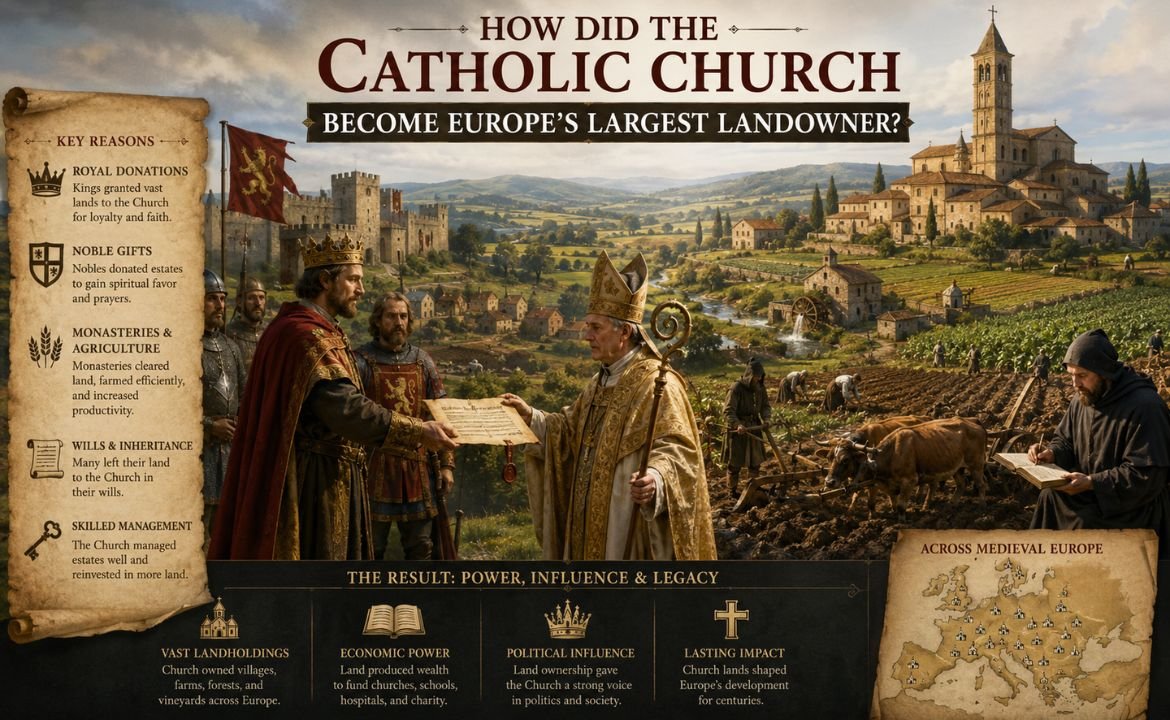
The question how did the Catholic Church become Europe’s largest landowner has interested historians for generations. The answer isn’t tied to one dramatic event. Instead, it reflects a long process that unfolded over hundreds of years. Through generous donations from kings and nobles, inherited estates, successful farming practices, and careful management of its property, the Church steadily expanded its landholdings. By the Middle Ages, it had become one of Europe’s most influential institutions, shaping not only religious life but also politics, education, agriculture, and the economy. Looking at this history helps us understand why the Church held such a powerful position across medieval Europe.
The Early Growth of Church Property
In Christianity’s earliest years, the Church owned very little land. Local congregations mainly depended on donations from believers to support worship, care for the poor, and maintain places of worship. As Christianity spread throughout the Roman Empire, many wealthy converts began donating homes, farmland, and other valuable property to churches.
As the religion gained wider acceptance, rulers started seeing the Church as an important partner in governing their kingdoms. Kings and emperors often rewarded bishops and other religious leaders with land to strengthen political alliances and encourage stability. These early gifts became the starting point for the Church’s growing estates.
Ordinary believers also contributed. Many people believed that donating land to churches or monasteries was a meaningful act of faith. Over time, these countless individual gifts added up, allowing Church property to expand steadily from one generation to the next.
Royal Donations Played a Major Role
One of the biggest reasons the Church accumulated so much land was the generosity of European rulers. Throughout the Middle Ages, kings regularly granted estates to monasteries, abbeys, and bishops.
These donations served several purposes. They rewarded loyal church leaders, helped spread Christianity into newly settled regions, and strengthened relationships between the monarchy and the Church. Supporting religious institutions also reinforced a ruler’s authority in the eyes of many people.
Some royal grants included entire villages, forests, farmland, rivers, and grazing areas. Over the centuries, these generous gifts greatly increased the Church’s presence across Europe.
Royal support became especially important during the early medieval period, when many kingdoms were still forming and needed reliable institutions to help maintain order.
Noble Families Also Expanded Church Wealth
Kings were not the only donors. Wealthy noble families also played a significant role in increasing Church land ownership.
Many nobles donated estates before their deaths as a way to express their faith. Others founded monasteries on their own land and transferred ownership to religious communities. In return, they believed monks and priests would remember their families in prayer and preserve their legacy.
Some donations followed major life events, such as surviving illness, returning safely from battle, or overcoming personal hardships. These gifts were often seen as acts of gratitude and devotion.
As similar donations continued over several centuries, Church-owned land spread across nearly every part of medieval Europe.
Monasteries Became Centers of Agriculture
Monasteries were far more than places of worship. They also became highly productive agricultural communities that managed large estates with impressive efficiency.
Monks cleared forests, drained marshes, planted vineyards, and introduced improved farming techniques. Land that had once been unused was often transformed into fertile fields capable of producing crops year after year.
These successful farming operations generated income through grain, livestock, vineyards, mills, and other agricultural activities. Many monasteries used those earnings to buy neighboring land, allowing their estates to continue growing.
Their careful planning and long-term management helped preserve Church wealth for generations.
The Feudal System Helped the Church Grow
The feudal system also contributed to the Church’s expanding landholdings.
During the Middle Ages, land represented wealth, influence, and security. Churches and monasteries often received estates in exchange for religious services, education, or administrative assistance.
Unlike noble families, whose estates were frequently divided among heirs, Church property usually remained under institutional ownership. Since it wasn’t split between family members, the land continued to grow over time instead of becoming fragmented.
This stability allowed many Church estates to become larger and more valuable than those owned by individual nobles.
Wills and Inheritance Added More Property
Another important source of Church land came through wills and inheritance.
Many wealthy landowners chose to leave part of their property to churches or monasteries. They believed these gifts reflected their faith while supporting charitable work after their passing.
In some cases, people without close heirs left their entire estates to religious institutions. Others donated only portions of farmland, vineyards, forests, or homes.
Although each donation varied in size, thousands of similar gifts made over many generations eventually created an enormous network of Church-owned property.
Good Management Helped Preserve Wealth
Acquiring land was only one part of the story. Managing it successfully was just as important.
Church officials kept detailed records, organized workers efficiently, and carefully supervised farming operations. Experienced administrators made sure estates remained productive and well maintained.
The income generated from these lands helped fund churches, monasteries, schools, hospitals, libraries, and charitable programs. Surplus income also allowed many religious institutions to purchase even more property whenever opportunities arose.
Because of this disciplined approach, the Church was able to maintain its wealth even during periods of political uncertainty.
Education Strengthened the Church’s Position
Another reason for the Church’s success was its educated leadership.
Many bishops, abbots, and monks could read, write, and keep accurate financial records at a time when literacy was relatively uncommon. Their administrative skills helped them oversee large estates effectively.
Religious institutions also preserved important books, educated future leaders, and copied valuable manuscripts that might otherwise have been lost.
Since many rulers relied on educated clergy to help administer their kingdoms, the Church maintained strong relationships with political leaders, which sometimes resulted in additional land grants.
The Church Also Faced Challenges
Despite its vast landholdings, the Church’s property was not always secure.
Wars, invasions, political struggles, and economic hardships sometimes damaged Church estates or reduced their income. In certain periods, rulers confiscated Church lands to strengthen their own authority or finance military campaigns.
The Protestant Reformation also led to the seizure of significant Church property in several European countries. Similar reforms took place in later centuries as governments restructured land ownership.
Even after these setbacks, the Church remained one of Europe’s largest landowners because its estates had been built over hundreds of years.
A Lasting Influence on Europe
The Church’s extensive land ownership had a lasting impact on European society.
Its estates supported farming, education, healthcare, charity, and cultural preservation. Monasteries introduced improved agricultural methods, cared for travelers, helped the poor, and protected valuable knowledge through their libraries.
Church-owned land also encouraged local trade and economic growth. Many towns and villages developed around monasteries and cathedrals, leaving a lasting influence that can still be seen across Europe today.
Conclusion
So, how did the Catholic Church become Europe’s largest landowner? The answer lies in centuries of steady growth rather than one defining moment. Royal grants, donations from noble families, inherited estates, productive monasteries, effective land management, and the stability of institutional ownership all contributed to its remarkable expansion. By combining spiritual leadership with practical administration, the Church built one of the largest collections of land in medieval Europe—an achievement that shaped the continent’s history for generations.
Disclaimer
This article is published by WorldMedia for informational and educational purposes only. While we strive to provide accurate, well-researched, and up-to-date content, the information presented is based on historical records, general knowledge, and publicly available sources that may be subject to differing interpretations.