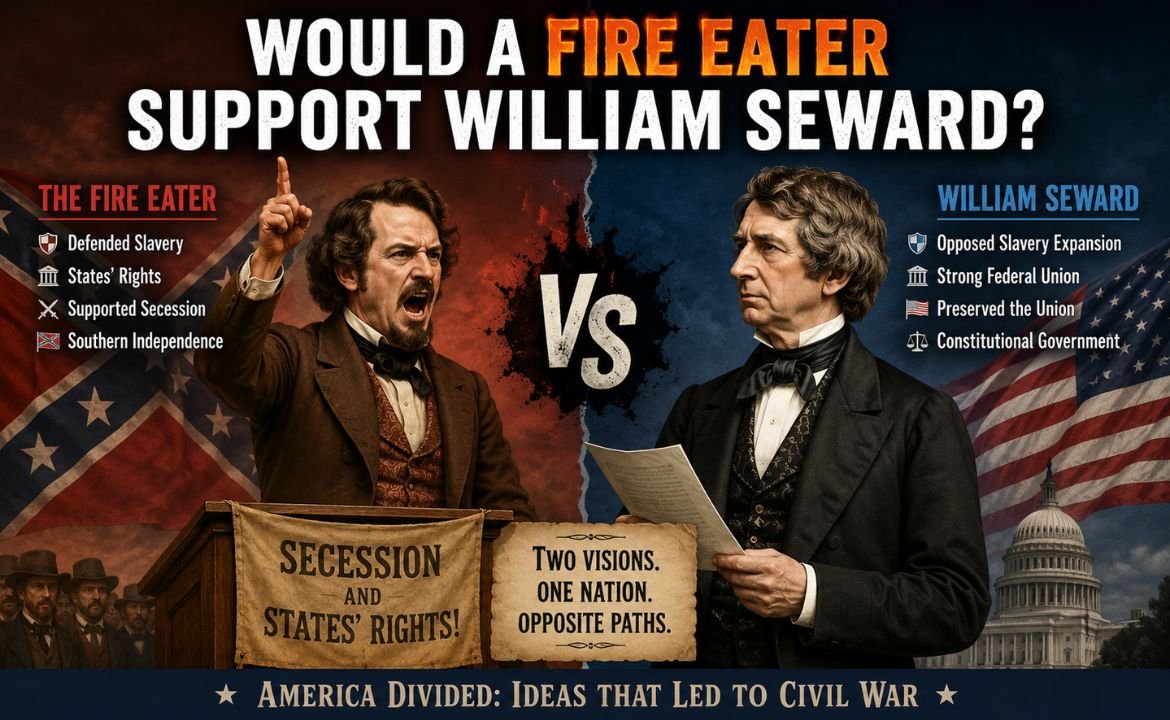
The question would a fire eater support William Seward takes us back to one of the most politically divided periods in American history. To answer it, we first need to understand who the Fire Eaters were and what William Seward stood for. Although both played influential roles in the years before the Civil War, they represented very different political beliefs and visions for the country’s future.
Looking closely at their ideas makes the answer fairly clear. A Fire Eater would have been highly unlikely to support William Seward. Their views on slavery, states’ rights, the power of the federal government, and the future of the Union were fundamentally opposed. This article explains the historical background of both sides and explores why their political philosophies left little room for agreement.
Who Were the Fire Eaters?
The Fire Eaters were a group of passionate Southern political leaders during the 1850s who strongly defended slavery and Southern interests. They believed that if the federal government threatened those interests, Southern states had every right to leave the Union.
Unlike politicians who hoped to reach compromises, the Fire Eaters argued that secession was the best solution. In their view, slavery was not only central to the Southern economy but also to its social and political structure. They feared that remaining in the Union would eventually weaken the South’s influence.
Many of these leaders openly encouraged resistance to Northern political movements, especially those that opposed the expansion of slavery into new territories. Their speeches and political campaigns helped build support for secession, making them some of the most influential voices in the movement that ultimately led to the creation of the Confederate States of America.
Who Was William Seward?
William Seward was one of the most prominent members of the Republican Party before the Civil War and later served as Secretary of State under President Abraham Lincoln.
Throughout his political career, Seward opposed the expansion of slavery into new U.S. territories. While his views became more refined over time, he consistently believed that slavery should not continue spreading across the country.
Seward also believed the United States should remain united. Unlike Southern secessionists, he argued that preserving the Union was essential to the nation’s future. His speeches often focused on constitutional principles, national unity, and moral responsibility, making him one of the North’s leading political figures.
Comparing Their Political Beliefs
Understanding would a fire eater support William Seward becomes much easier when comparing the principles each side defended.
Slavery
The issue of slavery created the deepest divide.
Fire Eaters believed slavery was essential to the South’s economy and way of life. They defended it politically, socially, and economically.
Seward took the opposite position. Although he respected constitutional boundaries, he opposed the expansion of slavery into new territories. That difference alone made political cooperation highly unlikely.
National Unity
The two sides also disagreed on the future of the Union.
Fire Eaters believed Southern states had the right to secede if they believed their interests were under attack.
Seward rejected that argument entirely. He believed the Union was permanent and should remain intact despite political disagreements. This fundamental difference placed both sides in direct conflict.
Federal Government
Another major disagreement involved the role of government.
Fire Eaters favored greater authority for individual states, especially when federal policies challenged Southern interests.
Seward believed a strong national government was necessary to preserve the Union and uphold federal law. Once again, their political philosophies moved in opposite directions.
Why Fire Eaters Opposed Seward
There were several reasons why Fire Eaters viewed William Seward as a political opponent.
First, he became one of the leading faces of the Republican Party, which opposed expanding slavery into new territories. Southern leaders considered this a direct threat to their economic and political future.
Second, Seward frequently described slavery as a moral issue, a position that many Southern politicians strongly rejected.
Finally, Fire Eaters feared that growing Northern political power would eventually weaken slavery throughout the country. Since Seward represented many of these Northern ideas, he became one of the individuals they criticized most openly.
Seward’s Vision for America
William Seward believed America’s future depended on remaining one united nation.
He supported national growth through economic development, better transportation, education, and constitutional government. Rather than dividing the country, he believed political disagreements should be resolved within the Union.
This vision differed greatly from that of the Fire Eaters, who increasingly argued that the South’s future depended on independence. Their competing ideas reflected two very different paths for the United States.
Could Any Fire Eater Have Supported Seward?
Some people wonder whether any Fire Eater might have supported Seward under different circumstances.
Historically, that seems very unlikely.
Doing so would have required abandoning many of the movement’s core beliefs, including support for slavery, states’ rights, secession, opposition to Republican policies, and resistance to Northern political influence.
While minor areas of agreement may have existed on isolated issues, they would not have been enough to overcome the deep ideological divide between the two sides.
Historical Context Matters
To fully understand this debate, it is important to view it within the political climate of the 1850s.
The nation was deeply divided over slavery, constitutional authority, economic interests, and regional identity. Political debates became increasingly heated, compromises became harder to achieve, and trust between Northern and Southern leaders steadily declined.
In this environment, both William Seward and the Fire Eaters came to symbolize opposing political movements. Their conflict reflected the growing national crisis that eventually led to the Civil War.
The Role of Republican Politics
The rise of the Republican Party further intensified tensions between North and South.
Republicans opposed the expansion of slavery, while Southern extremists viewed those policies as a serious threat to their way of life.
As one of the party’s most influential leaders, Seward naturally became a target of criticism. Supporting him would have directly contradicted the goals and public positions of the Fire Eaters.
Legacy of Their Conflict
The disagreement between William Seward and the Fire Eaters became part of the broader conflict that shaped the years leading up to the Civil War.
Seward continued serving the United States after the war and became well known for major diplomatic achievements, including the purchase of Alaska. Meanwhile, the Fire Eater movement played a significant role in encouraging Southern secession.
Today, historians continue to study both sides to better understand how political divisions contributed to one of the most important turning points in American history.
Conclusion
In the end, the historical evidence strongly suggests that a Fire Eater would not have supported William Seward. The two represented opposing beliefs about slavery, states’ rights, federal authority, and the future of the United States. While Seward worked to preserve the Union and limit the expansion of slavery, Fire Eaters pushed for secession and defended Southern interests. Their sharp disagreements illustrate the growing political tensions that eventually erupted into the Civil War, making any meaningful alliance between them highly improbable.
Disclaimer
The information provided in this article is intended for educational and informational purposes only. While every effort has been made to ensure the accuracy of the historical content, interpretations and historical perspectives may vary among scholars and sources. This article should not be considered professional academic or legal advice. WorldMedia publishes content to inform and educate readers, and we encourage readers to consult additional reputable historical resources for deeper research and verification. WorldMedia is not responsible for any decisions made based on the information presented in this article.